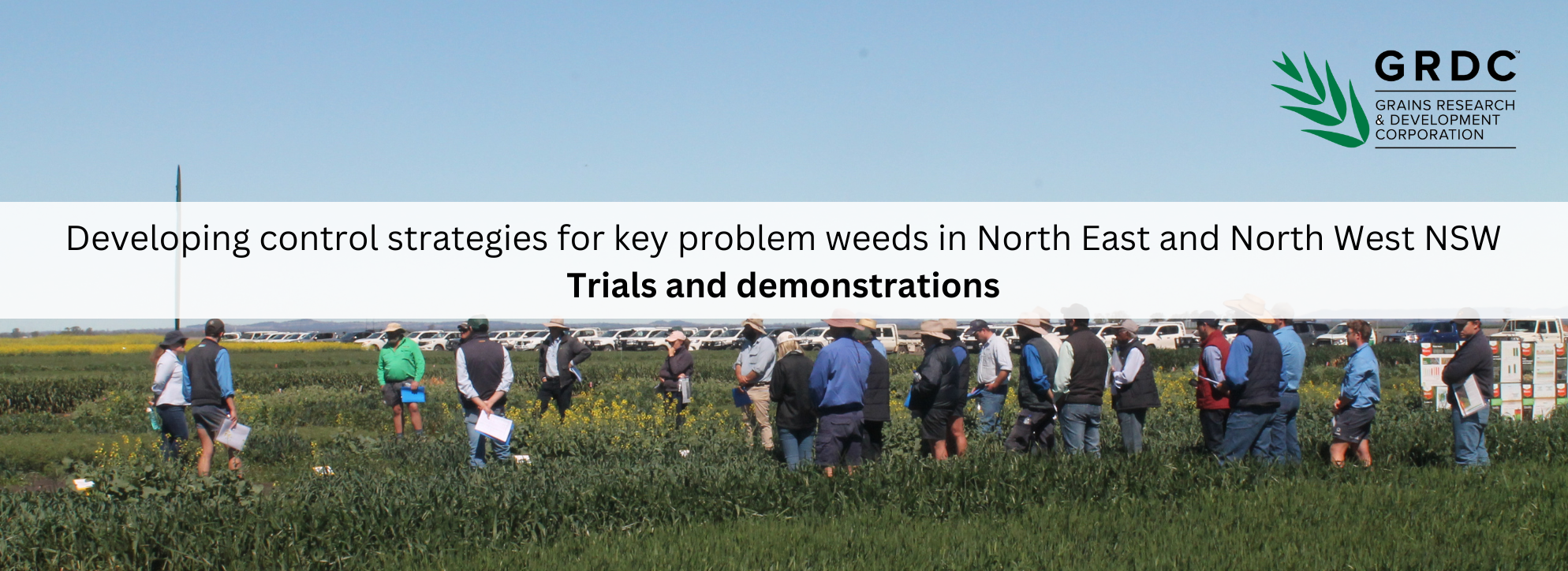
Protocols, results and field days will be added here as they are developed across the course of the project
Field walk
<< Click here to register for the Carroll field walk
Trial outcomes
2025/26 Control of elongating flaxleaf fleabane in fallow – OSST application rates - Gurley
 RESULTS - flaxleaf fleabane in fallow – OSST application rates
2025/26 Knockdown control of feathertop Rhodes grass and barnyard grass in fallow - Mallowa
RESULTS - Knockdown control of feathertop Rhodes grass and barnyard grass in fallow
2025/26 Do application conditions affect control of feathertop Rhodes grass and barnyard grass in fallow? - Mallowa
2025/26 Comparison of spray quality (droplet size) on performance of various herbicides in fallow - Mallowa
RESULTS - Comparison of spray quality (droplet size) on performance of various herbicides in fallow
2025/26 Does application timing influence antagonism/synergy with paraquat and glufosinate? - Mallowa
RESULTS - Does application timing influence antagonism/synergy with paraquat and glufosinate?
2025 Knockdown and residual control of broadleaf weeds in barley - Warialda UPDATED JUNE 2026
RESULTS - Knockdown and residual control of broadleaf weeds in barley
2025 Does water quality antagonise glyphosate for control of milk thistle? - Spring Ridge
RESULTS - Does water quality antagonise glyphosate for control of milk thistle?
2025 Comparative performance of Group 14 herbicides against advanced milk thistle - Spring Ridge
RESULTS - Comparative performance of Group 14 herbicides against advanced milk thistle
2025 crop safety when using cereal pre-emergent herbicides with disc v tyne seeders - Croppa Creek
2025 Comparison of early post-emergent options for control of phalaris in wheat - Gurley
RESULTS - Gurley comparison of early post-emergent opions for phalaris trial summary
2025 Improving the reliability of Group 1 herbicides in winter broadleaf crops - Rowena
RESULTS - Rowena group 1 winter reliability trial summary
2025 Glyphosate and glufosinate in mixtures with Group 14 herbicides – Milk thistle – impact of climate and weed size - Rowena
Pictures from the Rowena field walk showing treatment differences, February 2025
RESULTS - Rowena trial summary
2025 Knockdown control of milk thistle - broadacre and optical spot spray treatments - Bullarah
Bullarah milk thistle trial photos
RESULTS - Bullarah trial summary
2024 Glyphosate and glufosinate in mixtures with Group 14 herbicides - Awnless barnyard grass – Croppa Creek
Northern Grower Alliance trials
Northern Grower Alliance completed a multi-year analysis of residual herbicide trials to understand the effect of rainfall on herbicide persistence. Click here for the Update paper
Dose response of paraquat as a double knock application (NGA data)
Disclaimer: These documents are based on the results from individual trials. Variability in product performance is expected across trials and environments. Different outcomes are possible under different trial situations; brand of herbicide applied; environmental conditions before, at and following application; sprayer setup; adjuvant choice; water quality and spray volume; weed size and weed stress; and herbicide resistance status of the population. Trials seek to build on current knowledge – therefore this summary may contain experimental use patterns that are currently not specifically labelled for all of the weed(s) targeted in the trial, or treatments applied at a weed growth stage or application timing that may differ to the product label. In some circumstances, inclusion of a particular treatment is included to demonstrate why this product should not be used in that particular situation. Any research with unregistered agricultural chemicals or of unregistered products, rates or use patterns reported in this document does not constitute a recommendation for that particular use by the authors or the authors’ organisations. All agricultural chemical applications must accord with the currently registered label for that particular agricultural chemical, crop and region.
Any recommendations, suggestions or opinions contained in this publication do not necessarily represent the policy or views of the Grains Research and Development Corporation (GRDC) or Independent Consultants Australia Network (ICAN) or trial contractors. No person should act on the basis of the contents of this publication without first obtaining specific, independent, professional advice. The GRDC, ICAN and trial contractors will not be liable for any loss, damage, cost or expense incurred or arising by reason of any person using or relying on the information in these publications.